Government
St. Augustine Honored for a Century of Friendship with Spain
A St. Augustine honor with roots across the Atlantic highlights the relationships and traditions that still connect the Ancient City to Spain.
By Heather Vreeland
A small town in southern Spain has a museum devoted to Bernardo de Gálvez, the military leader whose name now appears on an international award presented to St. Augustine. When Mayor Nancy Sikes-Kline visited, she noticed something familiar among its artifacts: gifts left by earlier St. Augustine delegations.
The discovery was a reminder that the city’s relationship with Spain has never rested solely on dates carved into historic markers. It has been carried forward by people who travel, host visitors, compare notes, form friendships and arrive with something meaningful to exchange.
“That’s probably the most consistent tradition that we have,” Sikes-Kline said of the gifts exchanged between visiting mayors and delegations. “The exchange of gifts between mayors and friends.”
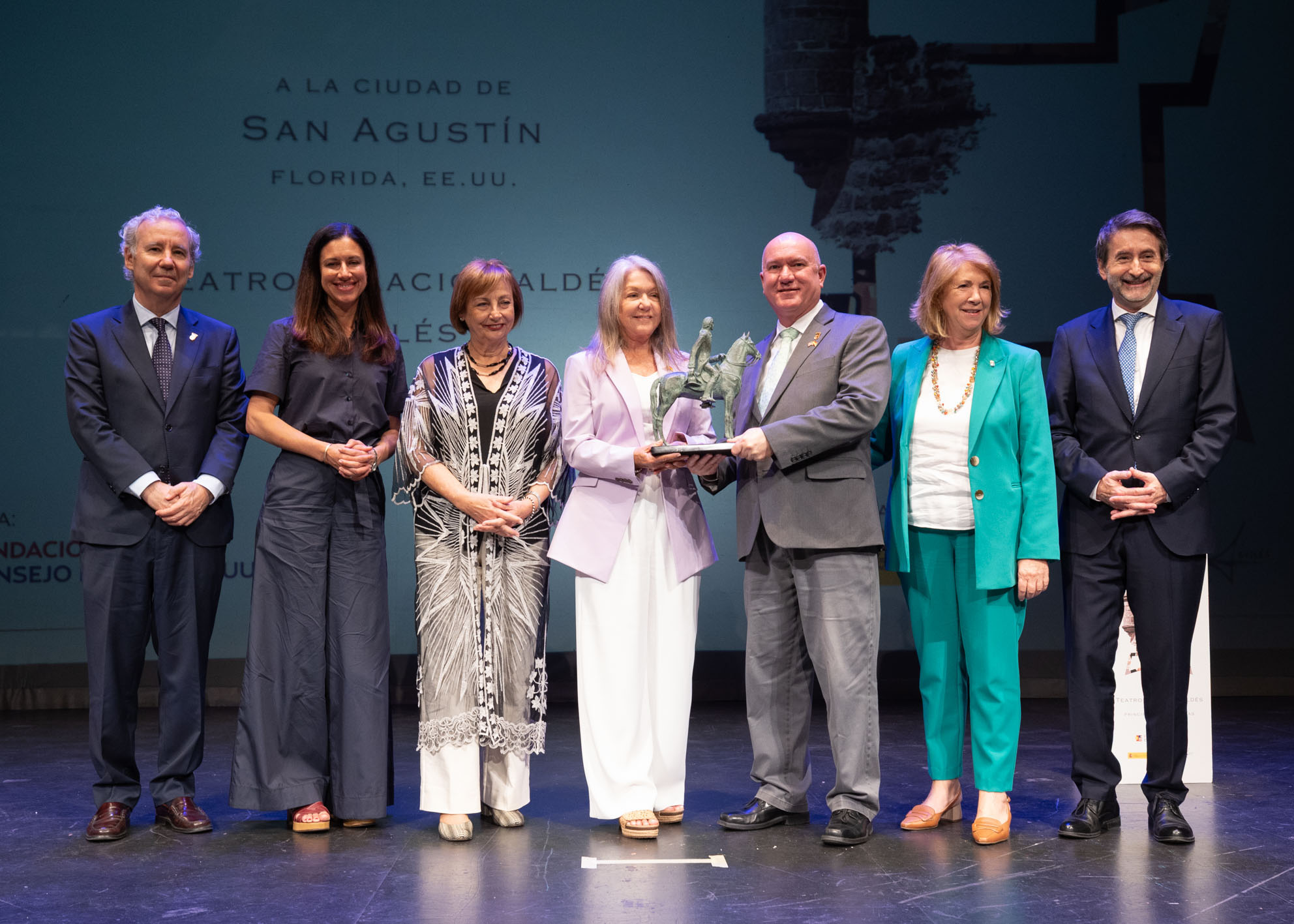
This year, that long-running friendship received recognition of its own. The Fundación Consejo España–Estados Unidos selected the City of St. Augustine for its 11th Bernardo de Gálvez Award, honoring institutions, organizations and communities that strengthen relations between Spain and the United States. The award was presented June 12 in Avilés, Spain, St. Augustine’s longtime sister city.
For a place whose Spanish roots are often condensed into a founding date—1565—the award acknowledges a more active and contemporary story. St. Augustine’s connection to Spain is visible in its architecture, traditions and historic street plan, but it has also been sustained through student exchanges, archaeological conversations, diplomatic visits, cultural programs and a century of formal ties with Avilés.
“I like to think that their award represents many, many years of just strong, strong relationship,” Sikes-Kline said. “There have been ins and outs, different reasons why sometimes it’s stronger than other times. But it’s lasted over 100 years now.”
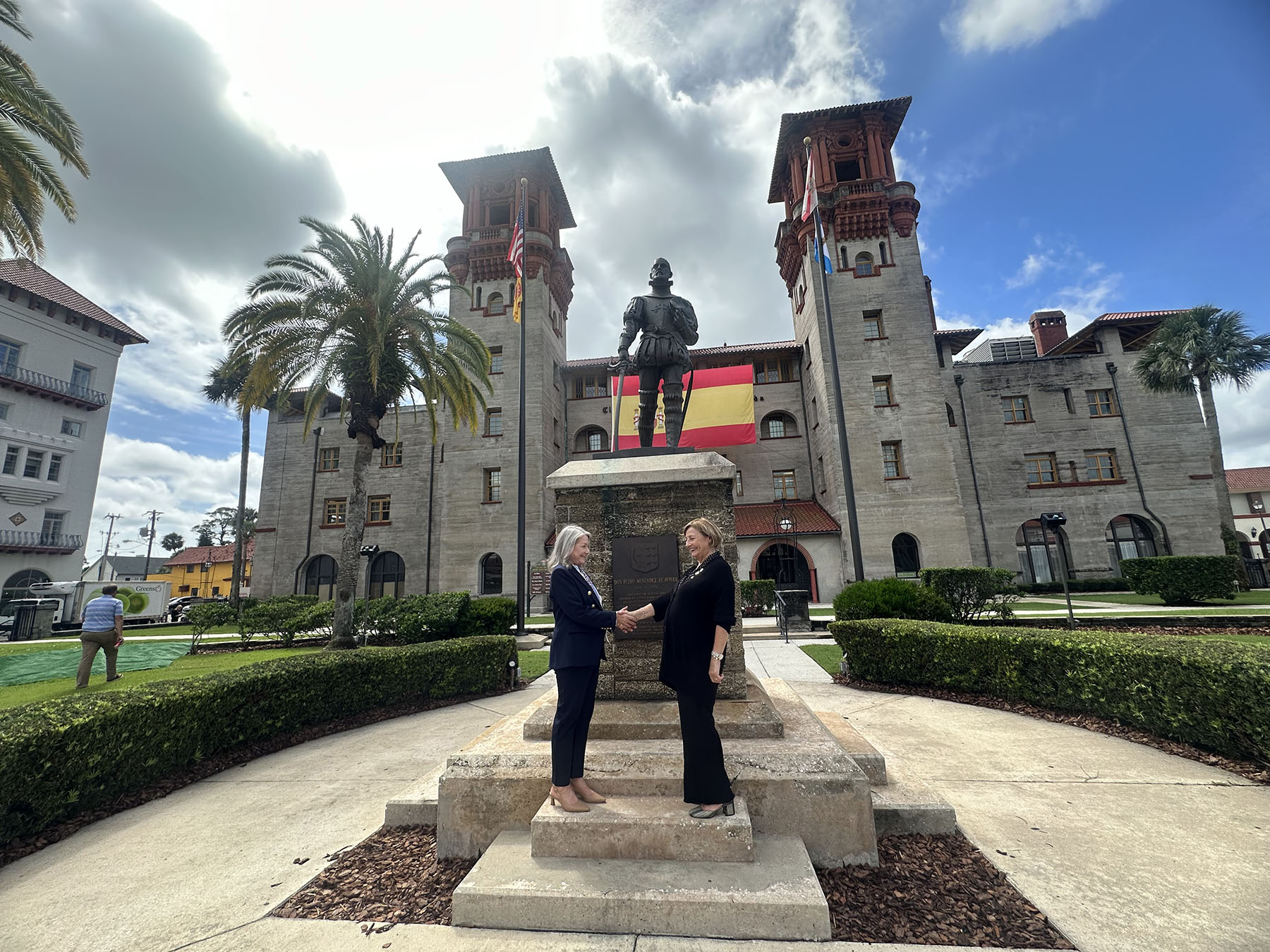
That century is an important distinction. St. Augustine was founded by Pedro Menéndez de Avilés, connecting the city to the Spanish port city associated with its founder. Yet history alone does not automatically create a working relationship between two modern communities. The St. Augustine-Avilés partnership has required repeated attention from city officials, Sister Cities volunteers, educators, tourism leaders and cultural organizations on both sides of the Atlantic.
In 2024, the cities celebrated 100 years of their sister-city relationship. Sikes-Kline used the anniversary as an opportunity to assemble a St. Augustine delegation that reflected the original breadth of the partnership: local government, the St. Johns County Chamber of Commerce, cultural organizations, tourism representatives, Sister Cities and Flagler College all had a place.
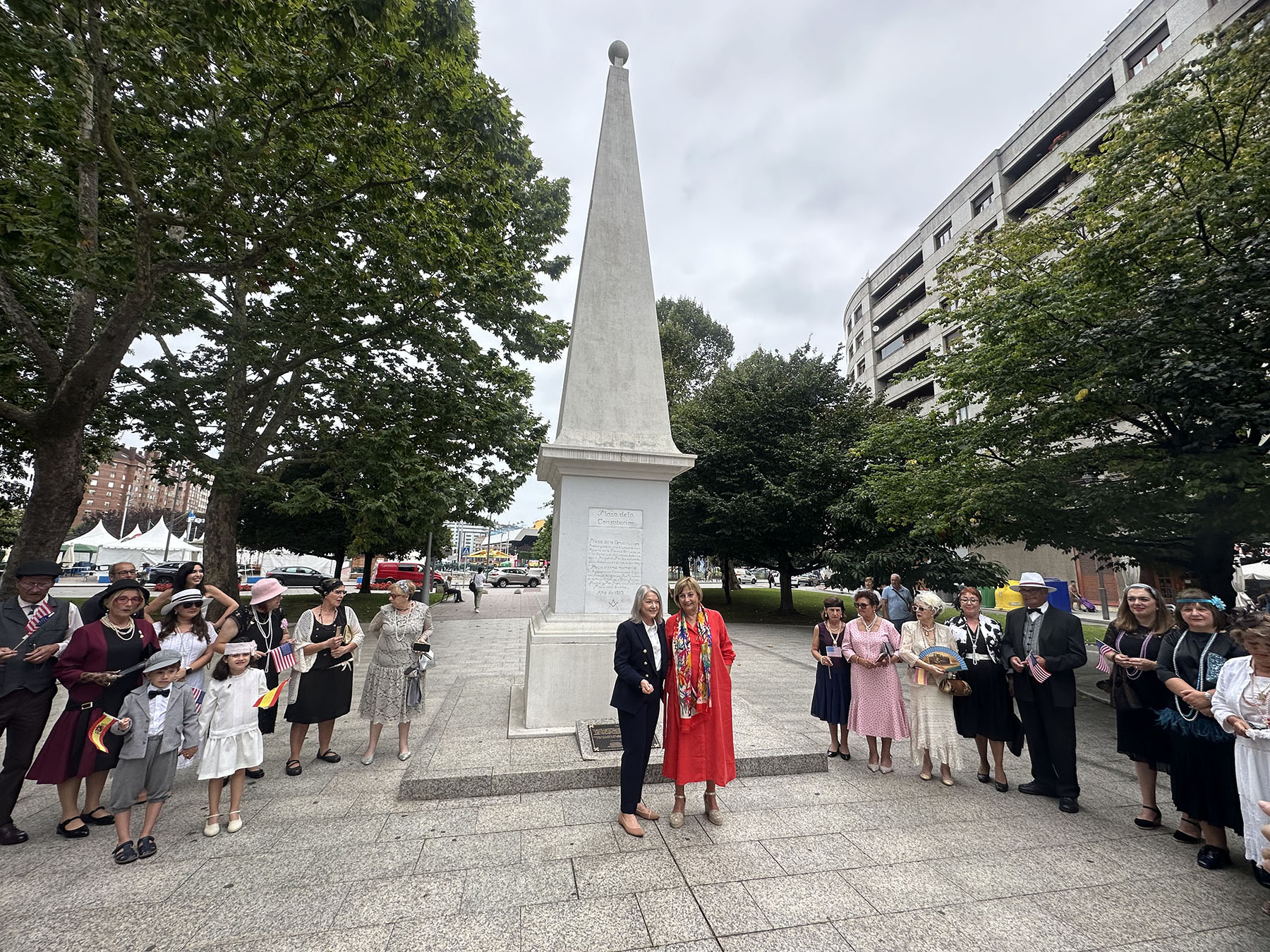
The mission of the relationship has long included education, culture, sports, tourism, trade and economic development. Rather than treating those categories as a ceremonial checklist, the delegation sought out counterparts in Spain who could continue the conversation after everyone returned home.
“It always comes down to that personal connection,” Sikes-Kline said. “You meet with someone, you connect with them, you want to continue that.”
One early result came through Flagler College, whose representatives visited the University of Oviedo and developed a memorandum of understanding between the institutions. The connection has opened the door to a college-to-university exchange, expanding on the high school student exchanges traditionally associated with Sister Cities programs.
That is the kind of outcome that makes an international relationship tangible locally. A student’s opportunity to study abroad, a professor’s new academic contact or an artist’s work sent overseas may seem far removed from the public ceremonies surrounding an award. But those individual connections are the real machinery of a sister-city relationship.
Over the years, that machinery has taken many forms. Sikes-Kline recalls exchanges between St. Augustine’s archaeological community and counterparts in Spain, along with visits by Spanish mayors and officials. She credits former city leaders, including Joe Boles and Tracy Upchurch, as well as Sister Cities advocates such as Lynn Weeks, with helping maintain the connection through different administrations and changing priorities.
There have been quieter periods, she said, particularly after St. Augustine’s 450th anniversary in 2015, when the city had hosted an extraordinary number of international visitors and events. But the relationship was never entirely lost. It simply awaited the next people ready to invest energy in it.
During the 450th commemoration, St. Augustine hosted the U.S.-Spain Council International Summit, bringing prominent business and government leaders from both nations to Northeast Florida. King Felipe VI and Queen Letizia of Spain visited the city that year, placing St. Augustine at the center of a historic celebration with international resonance. The city also welcomed Spanish diplomats and dignitaries during the 2021 observance of the 200th anniversary of Florida becoming a U.S. territory.
Those moments have brought global attention to St. Augustine. The ongoing work, however, happens at a more human scale: introductions made over a shared meal, meetings between schools, official visits that become friendships, and the careful choice of a gift that represents home.
For Sikes-Kline, the Gálvez Award also arrives at a moment when Spain’s role in American history is receiving fresh attention. As the United States marks its 250th anniversary, Spanish institutions and scholars are highlighting the contributions Spain made during the American Revolution. Bernardo de Gálvez led campaigns against British forces along the Gulf Coast, helping undermine British supply routes and control in the South.
It is a chapter of the Revolution that many Americans do not learn in depth, Sikes-Kline said. Yet it matters in St. Augustine, where the Spanish presence predates the United States itself and where the past is not tucked neatly inside a museum.
The city’s historic plan remains one of its most immediate connections to that past. The Plaza de la Constitución and the surrounding network of narrow streets reflect the Spanish colonial planning principles used in settlements throughout the Americas. Visitors may recognize the pattern in Old San Juan or Havana; St. Augustine residents encounter it every time they walk downtown.
“Our town plan is a national landmark,” Sikes-Kline said.
That physical inheritance is part of why St. Augustine’s Spanish history feels so close at hand. Still, the award recognizes something beyond the city’s age, its buildings or the obvious Spanish character of its historic district. Previous recipients have included the U.S. Library of Congress, the Meadows Museum and historian Stanley G. Payne. St. Augustine was selected, according to the foundation, for both its historical significance and its continuing efforts to preserve the shared legacy of Spain and the United States.
The word continuing is essential. The city’s connection to Spain does not survive because it is inevitable. It survives because each generation decides it is worth renewing.
That may mean a delegation traveling to Avilés for a centennial celebration. It may mean Flagler College students and faculty building a new relationship with the University of Oviedo. It may mean a local artist’s work crossing the Atlantic in the hands of a visiting official.
A century after St. Augustine and Avilés formalized their friendship, the relationship remains strongest in those exchanges—small gestures that turn a shared history into something residents can still shape.