Government
Sheriff Rob Hardwick Gives Impassioned Defense of His Record as County’s First Budget Hearing Focuses Heavily on Law Enforcement and Flock Cameras
Residents who spoke said they support law enforcement but not Flock.
By Fabrizio Gowdy
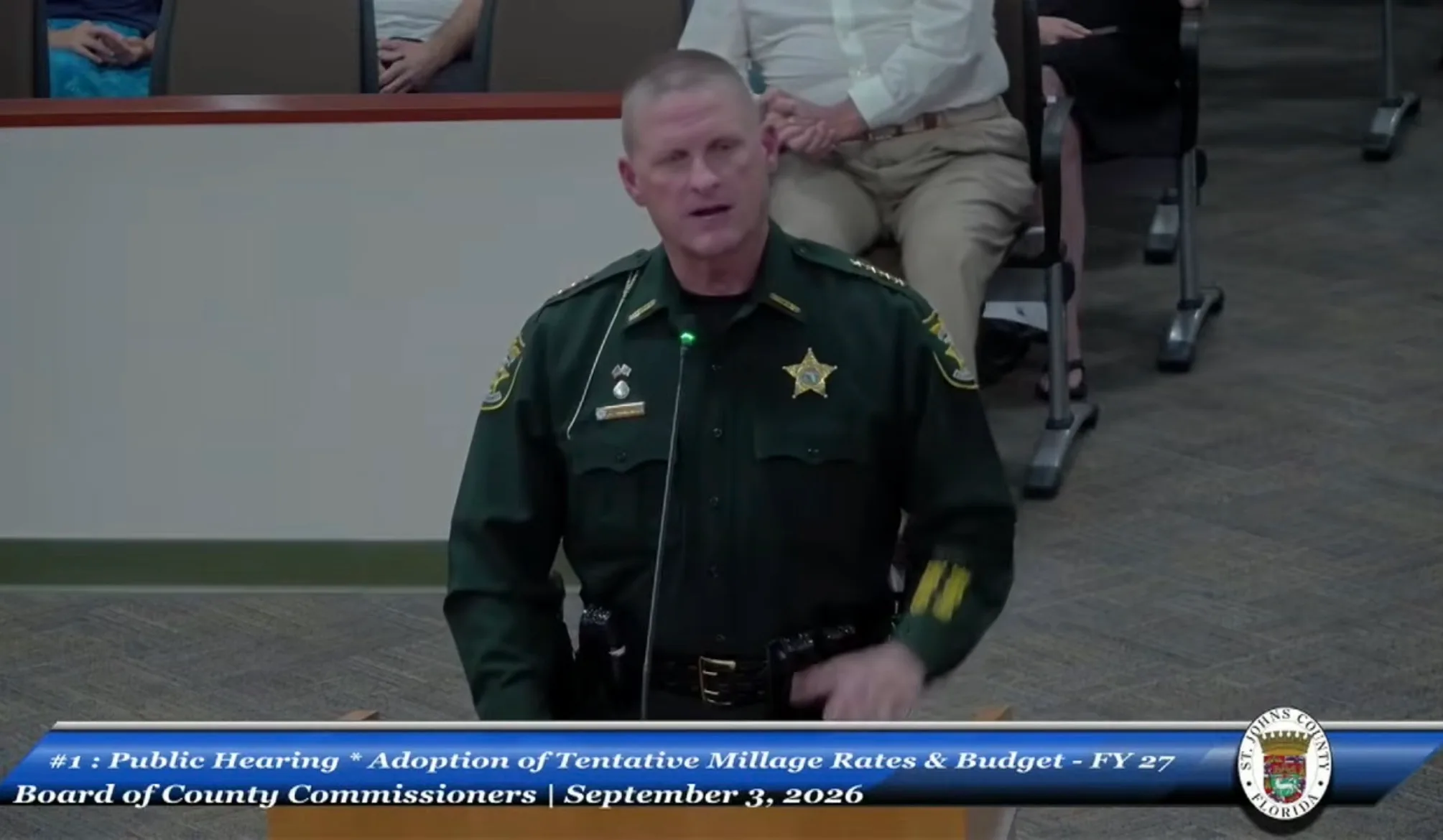
At the first public hearing held Thursday to consider St. Johns County’s budget and millage rate for the 2027 fiscal year, much of the discussion centered on the sheriff’s office and its use of Flock cameras.
According to Commissioner Christian Whitehurst, the overall budget is set to increase $27 million from last year, $21 million of which will go toward increasing the law enforcement budget. That includes $3.9 million St. Johns County Sheriff Rob Hardwick has asked for to provide a $9,000 annual salary increase for all deputies below the rank of sergeant — about 420 officers.
During public comment, several residents told commissioners they want to see more of the law enforcement budget invested in hiring additional deputies rather than spending funds on technology and AI tools.
“I don’t want our money to be spent on technology to catch criminals and replace our officers, we don’t need AI to take their place,” said Kailey Masters, who claimed officers risk their lives but are paid less than the entry-level maintenance techs she employs.
Other residents, including one man with a law enforcement background, said they were not anti-police but viewed Flock cameras as a violation of privacy rights.
On Thursday, the St. Johns County Sheriff's Office (SJSO) became the last agency in Northeast Florida to announce it would remove at least some of its automated license plate readers (ALPRs) in compliance with a state directive. It was not immediately clear if that move applies to all 180 cameras in the county, or only those on state roads.
Hardwick Responds
The public comment culminated with Hardwick taking the podium to offer a thorough defense of his tenure as sheriff. He touted significantly improved conditions at the jail, a fully staffed dispatch center, a more diverse workforce and better mental health and wellness services for employees.
Hardwick said officer pay has improved, but claimed retention remains a challenge because the Jacksonville Sheriff’s Office (JSO) offers higher pay and recently joined the Florida Retirement System, which could lure deputies north. He pointed out that some SJSO deputies had even found flyers on their cars recently encouraging them to join JSO, adding that Jacksonville Sheriff T.K. Waters had not authorized the messages.
“I don’t blame them for leaving, they can’t afford to live here,” said Hardwick.
Addressing the Flock controversy, Hardwick continued to insist the cameras were an invaluable law enforcement tool, but said he had been listening to residents’ concerns and had even contacted Riley Willis, founder of the group Deflock St. Johns, to set up a meeting. He claimed he would have no problem with a Flock camera being placed directly in front of his house.
“I got nothing to hide. I don’t smoke, I don’t drink, I believe in God and I love my wife — I’ve been married to her for 35 years,” said Hardwick.
He claimed that he had installed a camera outside his neighborhood because he and his family had been confronted in public and had received death threats. Commissioner Clay Murphy, a 39-year law enforcement veteran, also defended Flock cameras.
“I’d love for you to put one of those cameras in my front yard,” Murphy said.
Hardwick also claimed his agency was manually auditing spreadsheets to ensure license plates flagged by its Flock cameras were actually being used in legitimate investigations, and said his staff would be reporting findings to him by the end of the week.
Some residents pressed Hardwick to explain where he planned to spend the savings from removing Flock cameras. He claimed that of the $908,000 budgeted for ALPR tech, a grant covered all but $481,000, which he suggested could now be redirected to paying off leases and loans for agency vehicles and programs at the jail.
Overall Budget
Though law enforcement is a major portion of the county’s planned expenditures, it only represents a fraction of the $1.94 billion budget commissioners are set to approve later this month.
Commissioners are eyeing a 6.7559 millage rate, which is expected to generate $426 million in ad valorem taxes. Additional funding will come from special funds, impact fees and other sources.
The second and final public hearing will be held Sept. 15 at 5:01 p.m., at which point commissioners will approve a final millage rate and budget.