People
How Ketterlinus Elementary School Helped Shape an Early Literacy Movement
For more than a century, Ketterlinus Elementary School has held an important place in the heart of St. Augustine. After Elizabeth Ketterlinus donated the land to the St. Johns County School Board and
By Heather Vreeland
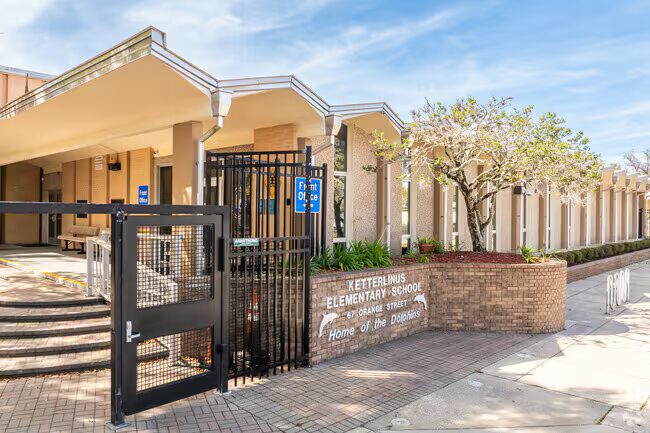
For more than a century, Ketterlinus Elementary School has held an important place in the heart of St. Augustine. After Elizabeth Ketterlinus donated the land to the St. Johns County School Board and construction was completed, the campus first served as St. Augustine High School, later became a junior high school, and in 1991 took on its current role as an elementary school.
Through each chapter, the school has reflected the needs of its community. But in recent years, Ketterlinus has also become part of a much larger story — one that reaches far beyond St. Augustine and into classrooms across the country.
That story begins with a question familiar to many educators and parents: What happens when children are working hard, teachers are working hard, but the reading results still are not where they need to be?
For Ketterlinus Principal Kathy Tucker, the answer was not to accept the system as it was. Since becoming principal in 2010, Tucker has built a reputation for being willing to take thoughtful risks when she believes students and teachers need something better. That leadership helped earn her recognition as the 2025 Principal of the Year, but one of her most meaningful contributions may be the role she played in helping spark the development of what would become the University of Florida Literacy Institute’s UFLI Foundations program.
UFLI, pronounced “you fly,” is part of the University of Florida College of Education and is focused on improving literacy outcomes by strengthening both teacher knowledge and student reading development. Its work is grounded in the science of reading, an evidence-based approach that emphasizes the importance of explicit, systematic instruction in the foundational skills children need to become confident readers.
At Ketterlinus, that work became more than theory.
Several years ago, Tucker reached out to the University of Florida Literacy Institute seeking professional development support for her teachers. The request was practical and urgent. Teachers needed better tools. Students needed stronger reading instruction. The school needed a more consistent, research-based approach to help children build the foundational skills that make reading possible.
Dr. Holly Lane, director of UFLI, responded with lessons and support. What began as a way to help one school soon grew into something much bigger. Lane has referred to the early version of the work as an “accidental phonics program,” but the results were anything but accidental. Ketterlinus became a proving ground where the lessons could be used, refined, and tested in real classrooms with real teachers and real students.

That role matters. Curriculum does not become powerful simply because it is written by experts. It becomes powerful when teachers can use it, students can respond to it, and schools can build a culture around it. Ketterlinus gave UFLI a place to see how explicit, systematic reading instruction could work inside the daily rhythm of an elementary school.
The timing was far from easy. In 2020, Tucker and her teachers were preparing to begin implementation when the pandemic disrupted education across the country. Students moved in and out of remote learning. Schools were consumed with safety protocols, shifting schedules, and uncertainty. But even in the middle of that upheaval, Ketterlinus continued to focus on literacy.
That decision proved important. As students returned to classrooms, the need for strong foundational reading instruction became even more urgent. The UFLI approach gave teachers a clear, consistent structure. Lessons helped students connect letters and sounds, decode words, break apart multisyllabic vocabulary, and build confidence through practice and repetition. Instead of guessing at words or memorizing them in isolation, students were taught how written language works.

The program also gave teachers something equally valuable: shared language, shared routines, and a shared understanding of how children learn to read. That consistency created stability across classrooms. Students knew what to expect. Teachers had a clear sequence to follow. Reading instruction became less dependent on individual interpretation and more grounded in a common, evidence-based framework.
Soon, the progress at Ketterlinus became difficult to ignore. Students began making measurable gains, and the school’s performance drew attention across the district. As Ketterlinus students began outperforming some schools with more affluent populations, district leaders started asking a simple question: What are you doing?
The answer was not a shortcut. It was not a single classroom strategy or a quick intervention. It was a schoolwide commitment to equipping teachers with the tools, training, and structure needed to teach reading more effectively.
Since those early lessons were shaped and refined, UFLI Foundations has grown far beyond its original pilot classrooms. Alachua County Public Schools implemented the program across its K–2 classrooms, while Duval County Public Schools expanded UFLI Foundations to all kindergarten through second grade students after piloting it in dozens of elementary schools. Hillsborough County has used the program for K–2 reading instruction and as remediation for struggling readers in upper elementary grades, while Hardee County has also implemented UFLI Foundations with kindergarten, first and second grade teachers. Beyond Florida, districts such as Orchard Park Central School District in New York have adopted the program as part of their early literacy instruction, reflecting how a model shaped through classroom practice has become part of a larger national shift toward explicit, evidence-based reading instruction.
The story of Ketterlinus Elementary’s role in literacy reform reached a national audience through Reading Reboot: How We Can Solve America’s Reading Crisis, a WLRN documentary presented through PBS and hosted by bestselling author James Patterson. The film examines the country’s ongoing reading crisis and highlights how the Science of Reading is changing instruction in elementary classrooms. Among the schools featured is Ketterlinus Elementary in St. Augustine, which WLRN identifies as an early pilot site for the approach in 2020. The documentary follows how Principal Kathy Tucker and her teachers moved forward with UFLI-based instruction during the disruption of the pandemic, creating the consistency and explicit phonics instruction students needed. What began as a local effort to better support young readers became part of a much broader conversation about how schools can help more children become confident, capable readers.
For St. Augustine, the remarkable part of the story is that one of the sparks for this national literacy work came from Ketterlinus Elementary School.
Tucker’s role was not that of a curriculum author or university researcher. Her role was that of a catalyst. She recognized that the existing approach was not meeting every child’s needs, and she was willing to invite something different into her school. She trusted her teachers, partnered with experts, and kept students at the center of the decision. As Tucker reflected on the risks she has taken on behalf of children and teachers, she said, “If my career ended today by taking those risks, I’m okay with it. I feel rewarded.” For the students who found confidence in reading, the teachers who gained stronger tools, and the classrooms now using UFLI Foundations far beyond St. Augustine, those risks have already left a lasting mark.