Government
County Commissioners Vote to Lawyer Up, Fight Agricultural Enclave Law in Court
Commissioner Clay Murphy cast the deciding vote.
By Fabrizio Gowdy

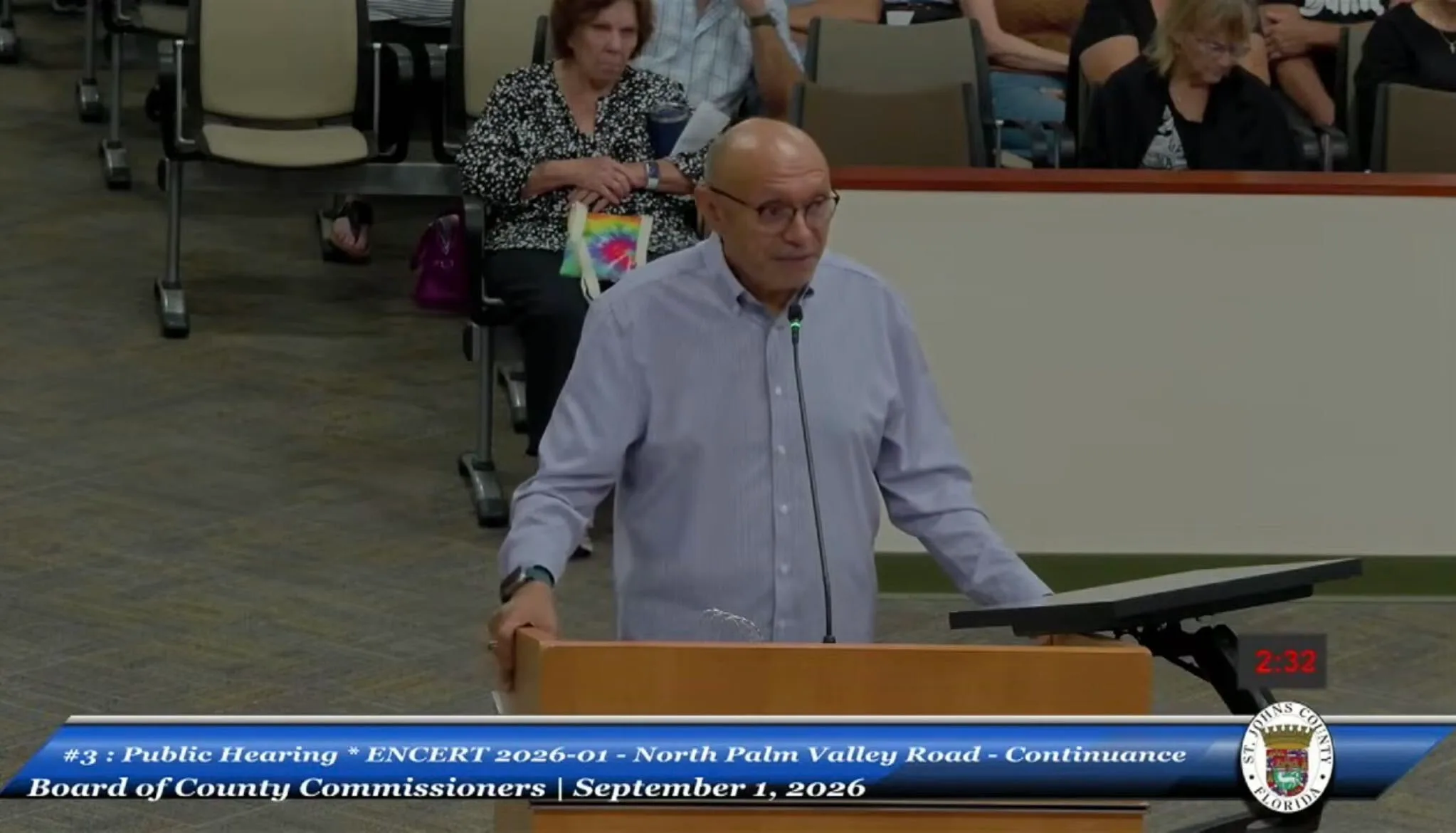
After more than four hours of discussion and debate featuring public comment from dozens of speakers, St. Johns County Commissioners voted 3-2 Tuesday to begin the process of seeking an injunction against SB 686, a new state bill some critics have dubbed the “Paving over St. Johns County law.”
SB 686 creates a process by which land actively used for agriculture can be fast-tracked for rezoning and development if it meets criteria to qualify as an “agricultural enclave,” meaning it is mostly surrounded by existing development. The bill’s sponsor, Ocala homebuilder and state Sen. Stan McClain, argued it encourages infill, but critics claim it creates a “leapfrog effect” that will cause sprawl.
The commission’s vote Tuesday came as it considered a rezoning request that would have allowed one home per acre to be built on 4,462 acres bordering the Intracoastal Waterway in the county’s northeast. The item had been continued from the Aug. 19 meeting after commissioners questioned whether the property boundaries met SB 686’s criteria and whether the land had actually been used for silviculture.
Importantly, commissioners did not approve or deny the rezoning, meaning it will automatically be approved under SB 686 unless the county acts before the end of September.
From the outset it was clear that Commissioners Krista Joseph and Ann Taylor would oppose the rezoning, and Commissioners Sarah Arnold and Christian Whitehurst would support it. That meant the decision rested in the hands of Commission Chair Clay Murphy, who has emerged as the commission’s swing vote on development.
Murphy was elected in 2024 on a slow-growth platform alongside Taylor, ousting incumbent Roy Alaimo, but has taken heat from opponents of development for approving some projects, including two agricultural enclave rezonings at the previous meeting.
One resident made a direct appeal to Murphy.
“Vote to deny,” said Chris Vandenberg. “Go home, hang your hat, rest peacefully knowing you made the right decision and wake up tomorrow knowing you can look the people of St. Johns County in the eye.”
Others who spoke included candidates challenging incumbent Reps. Kim Kendall and Sam Greco. Art Stresing, who is taking on Kendall, criticized her for voting for SB 686.
Speaking on behalf of the developer was attorney Ellen Avery-Smith, who sought to address doubts raised at the previous meeting.
She produced an affidavit from Callahan Timber President Jim Coleman, who attested the land had been continuously used for forestry and logging for years. She added that she had submitted 550 pages of documents to corroborate that claim, including sales records and forestry management plans.
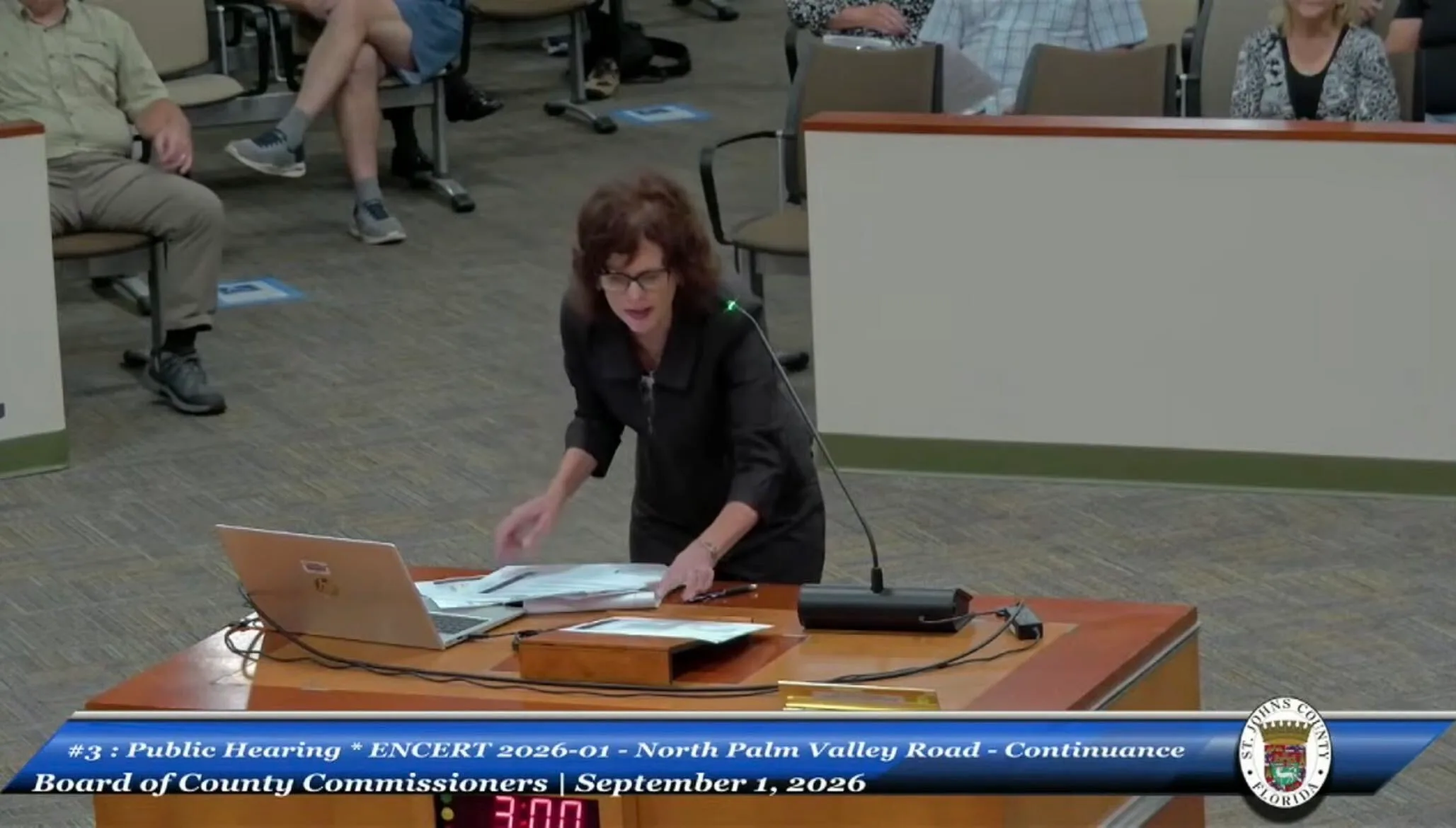
Staff also reported that after completing a second review requested by commissioners, the property boundaries did narrowly meet the state’s requirements. Commissioner Joseph continued to raise doubts and press Avery-Smith for specific parcel numbers.
“It seems to be our right that we should not be rushed in this kind of a development that you guys will make millions of dollars on,” said Joseph. “It’s really sad we’re supposed to decide this in 30 days.”
In response, the attorney cited Ponce Inlet v. Pacetta, a case she claimed gives property owners broad leeway to define their own property boundaries through a “metes and bounds” legal description.
Avery-Smith insisted the commission needed only to address her client’s application, but several speakers argued commissioners’ decision Tuesday would serve as a test case and set a precedent beyond St. Johns County.
“You’re fighting on behalf of the whole state — every other county right now is watching this with bated breath,” said Carrie Hersel.
Breaking two hours of silence, Whitehurst pointed to several other developments he had voted to reject, but said that rejecting the proposal before the board Tuesday would be like running headfirst into a wall. He argued the only result would be costly, unwinnable litigation for the county.
“I have voted to deny many projects all over this county,” said Whitehurst. “I’m not afraid of a fight, I’m not up here doing favors for developers, but I’m also not going to cast my vote just to get applause.”
However, numerous residents explicitly told the board they wanted the county to spend tax dollars fighting developers in court. Eventually, Murphy moved to direct staff to do exactly that.
“Nobody wants this,” said Murphy. “I think we need to fight it at the source.”
Joseph immediately moved to deny the application and was joined by Taylor, but Murphy voted against the motion. He argued that denying the application would only give the developer the chance to sue.
Moments later, Whitehurst moved to approve the application, which Arnold seconded. Murphy again voted no, leaving the commission at an impasse. Murphy’s original motion to seek an injunction eventually passed 3-2 with Joseph and Taylor’s support.
A precise timeline for the next steps is not clear, but the county will have to move fast. SB 686 states that if local governments do not act on agricultural enclave rezonings within 90 days, they are automatically approved. The application was one of six filed July 1, the day the bill took effect, so that 90-day deadline falls at the end of September.
Opponents of the developments who packed the lengthy meeting Tuesday were clearly happy with the commission’s decision, even if much remains to be settled. One speaker, who immigrated to the U.S., said he felt like he was “witnessing America in action.”
“I’m in this country for 35 years, but today you all really warmed my heart, and made me feel like the decision I made to leave my country and come to the United States was the right one,” he told commissioners.