Government
County Commissioners Approved a $1.94B Budget. Here’s What’s in it and How Amendment 3 is Shaping the Picture.
See how county budget director Wade Schroeder fielded our questions.
By Fabrizio Gowdy
St. Johns County is building up its reserves, holding vacant positions open and putting roughly $100 million in capital projects on pause as it braces for the possibility that voters approve Amendment 3 in November.
Those are some of the steps county Budget Director Wade Schroeder says officials have taken while putting together the county’s roughly $1.94 billion budget for the 2027 fiscal year, which Commissioners adopted on Sept. 15.
The county says there were no changes between the first hearing and the budget going before commissioners for final approval.
The county will keep its countywide millage rate unchanged at 4.4999 while increasing reserves by roughly $30 million — a decision Schroeder said is a direct response to Amendment 3 in mind.
“The $30 million increase in reserves would not even fully offset the FY 2028 revenue impact,” Schroeder said, adding that the county would have to find additional service reductions or alternative revenue sources.
If approved in November, the proposed constitutional amendment would significantly reduce property tax revenue available to local governments. In St. Johns, Schroeder estimates it would cost the county $68.3 million in fiscal year 2028, twice the amount the county is adding to reserves. He projects the annual impact would grow to $136.1 million the following year and $191.6 million by 2032.
The county has also declined to add about $2 million worth of requested positions, while another $2.6 million in newly approved positions will remain paused until after the election. Vacant existing positions are also generally being left unfilled for now, representing another approximately $4 million in potential annual savings, according to Schroeder.
A much larger source of savings is roughly $100 million in already funded capital projects the county has placed on hold until Floridians vote on Amendment 3.
As for the spending that is going forward uninterrupted, public safety will consume most of the growth in property tax collections. Schroeder said the county expects to collect about $26.9 million more in property taxes than it did last year, with approximately $19.1 million — 71% of that increase — going to the Sheriff's Office and Fire Rescue.
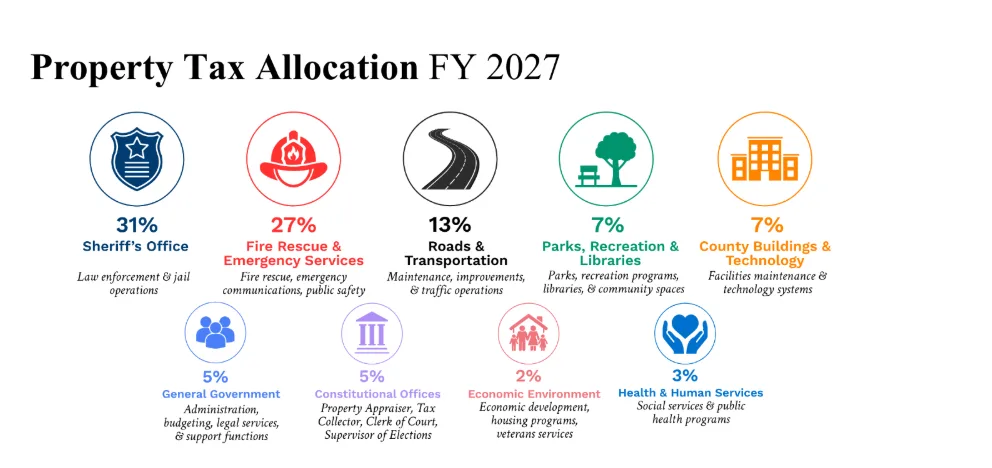
Public safety already receives the majority of property tax dollars: 31% goes to the Sheriff's Office and 27% to Fire Rescue and emergency services. Roads and transportation account for another 13%.
Specifically for the funds generated by property taxes, all other budget items make up less than 30% combined. Parks, recreation and libraries account for 7%, county buildings and tech are another 7%, and general government and constitutional offices each account for 5%.
Health & Human Services makes up just 3%, and 2% is spent on economic development, housing programs and veterans services.
Schroeder emphasized that most of the $1.94 billion budget does not come from property taxes, which pay for just 22% of the budget. Utilities, solid waste and impact-fee programs with restricted uses account for the rest of the county’s funding.
That distinction also applies to roughly $300 million in additional debt planned over the next five years. Schroeder said the borrowing is for utility infrastructure and will be repaid through utility charges rather than property taxes or the General Fund. Commissioners have approved multiyear water and sewer rate increases beginning in FY27 to support that borrowing.
Asked if he is confident the county’s tax base will continue to grow fast enough to handle the new debt, Schroeder pointed to the county's bond ratings, which Moody’s upgraded from Aa2 to Aa1 earlier this year.
Among the more interesting items in the 1,362-page budget is a $3.8 million beach-access trolley which would initially run from Vilano Beach north through South Ponte Vedra Beach. The project is intended to increase the state and federal beach renourishment funds the county receives, though it is also being pitched as an effort to improve beach access.
The route, stops, fares and hours remain under development according to Sloane Stephens, the county’s Coastal Project Manager. An Initial Community Meeting on the proposal will be held on Oct. 7 from 4 to 7 p.m. at 505 Guana River Road.
Another notable line item is the nearly $6 million budget for the eight-employee Office of Performance & Transparency, including about $1.48 million for consulting and $1.61 million for right-to-use software.
Schroeder said much of that spending is tied to the county's new Workday enterprise software system, which combines functions previously handled by separate financial management, procurement, budgeting and other systems.
The county expects savings as older software licenses are eliminated, but Schroeder acknowledged the county is still implementing the technology and those savings “have not yet been realized.”
Schroeder also defended the $170,000 the county approved last year to build a TV and podcast studio, which he said will “enable the Office of Public Affairs staff to continue producing award-winning communication programming that supports the strategic Plan priority of ‘community trust.’” The studio is expected to be operational by early 2027.
“Creating original podcasts and video shows will allow us to develop proactive communication to foster engagement and build an environment of public participation,” he said.